Exceptional Transport Application
Before exceptional transport takes place:
- A consignment is checked for exceptional consignment characteristic.
- The consignment with exceptional characteristics requires a transport authorisation.
- The consignee sends to the railway undertaking an order for an exceptional consignment authorisation with conditions of carriage.
- The railway undertaking obtains an authorisation with transport conditions from the infrastructure manager.
- In international transports, the authorisation conditions are shared with all other participating railway undertaking.
- In national transports, the authorisation conditions are shared with consignee.
Communication between the railway undertakings and infrastructure managers is carried out in a standardized form, which derives from the rules set in the UIC document IRS 50502 "Exceptional Consignments – Regulations concerning the preparation and management of conceptional consignments". These rules are binding for all UIC railway undertakings involved in the international transports of exceptional consignments.
Appendix B of the UIC IRS 50502 document contains a template of a form of written communication, with 38 codes.
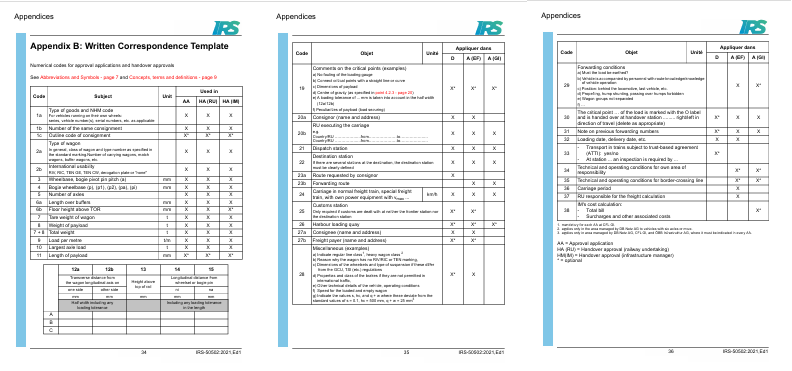
These codes can be grouped into the four main elements of exceptional transports:
- Goods Data – refers to the specific goods that need to be transported.
- Goods Data – refers to the details of wagon suitable for the transport of the goods.
- Route Data – refers to the route ordered by the consignee.
- Conditions – refer to the specific technical or operational requirements ordered by consignee and for which infrastructure manager sets and approves conditions of carriage.
The infrastructure manager examines the carriage conditions for the set of the wagon with cargo on the paths within his railways network. Practice shows that in the application forms usually codes 1–32 are filled by railway undertakings. In reply, the infrastructure manager sends the permit with some of these 32 codes. In Appendix B of the UIC IRS 50502 there is guidance regarding which codes are obligatory for each entity in the approval process.
International written communication is conducted in one of the three official UIC languages:
- English.
- French.
- German.
In urgent cases sending approval applications in other non-official languages is accepted. In countries where the official UIC languages are not national languages, it is the responsibility of the railway undertaking to translate the content of the application into the national language.
This project describes each one of the four application elements, with the focus on the application codes which describe goods, wagons, and route data.